





Modern Movement
Blurring the Line between House and Garden
The Landscape Design Challenge
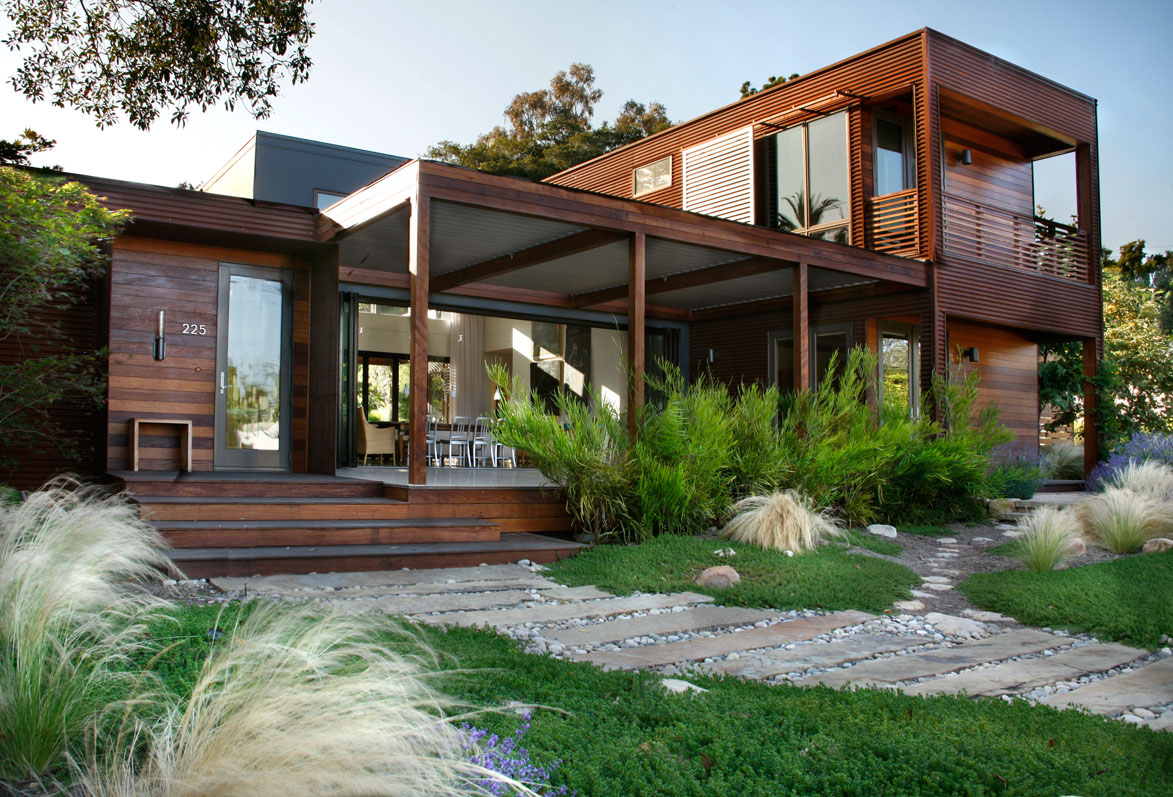
The beautiful new home and studio -- designed by famed architect Michelle Kaufmann (www.MichelleKaufmann.com) -- was the project for which Margie Grace won the International Landscape Designer of the Year Award from the Association of Professional Landscape Designers. The project has won numerous awards and been featured in more than a dozen publications.
Kaufman's modular structures were built on a flat, heavily excavated and re-compacted city lot on Pedregosa Street in Santa Barbara, California. True to its name (pedregosa = rocky in Spanish), the site was piled high with unfathomable quantities of sandstone boulders - all unearthed during site preparation for the new structures. There were also nearly 200 cubic yards of sandstone rubble, a nice pile of salvaged sandstone curbstones and a beautiful pre-existing cut sandstone wall. All of the stone was to remain on site and be incorporated into the landscape. New and existing stonework were to blend seamlessly and somehow the landscaping needed to tie together the new home's modern architecture and the neighborhood's venerable historical homes, some dating back to the late 1800's.
The clients wanted spaces for quiet contemplation, rejuvenation, lively discussions, lovely meals and musical evenings. They also wanted a handful of fruit trees and universal access. Naturalistic gardens would be extensions of the home's living space.
Site drainage and flood control were really troubling issues. The main house sits in a low spot and a 3' diameter pipe carrying what once was an ephemeral stream bisects the property, running under the master bedroom. These issues had not been addressed by site engineering; by default, they would have to be addressed in the landscape design.
Everything was to be "super-green". We wanted to retain storm water on site, use trees for climate control and use no chemicals or power tools for maintenance. Oh, and maintenance needs were not to exceed half a day per month (ha!). Finally, the clients, recent Iowa transplants, requested "a little bit of home" -- a prairie feel -- be incorporated into the landscape; yet the gardens must retain a strong sense of place to be successful.
The Landscape Design Solution
Terracing, boulder placement and land contouring bring form, interest and flow to the once-flat space, providing distinct spaces with distinct "feels" and uses. A stone amphitheater and fire pit are the center of social gatherings. Fixed seating on one side of the fire pit allows for the other side to serve as stage, additional seating, or a place to lay out sleeping bags to enjoy fine weather. The cedar hot tub is situated near the fire pit - sufficiently distant to allow for quiet moments yet sufficiently near to enjoy the flame while soaking.
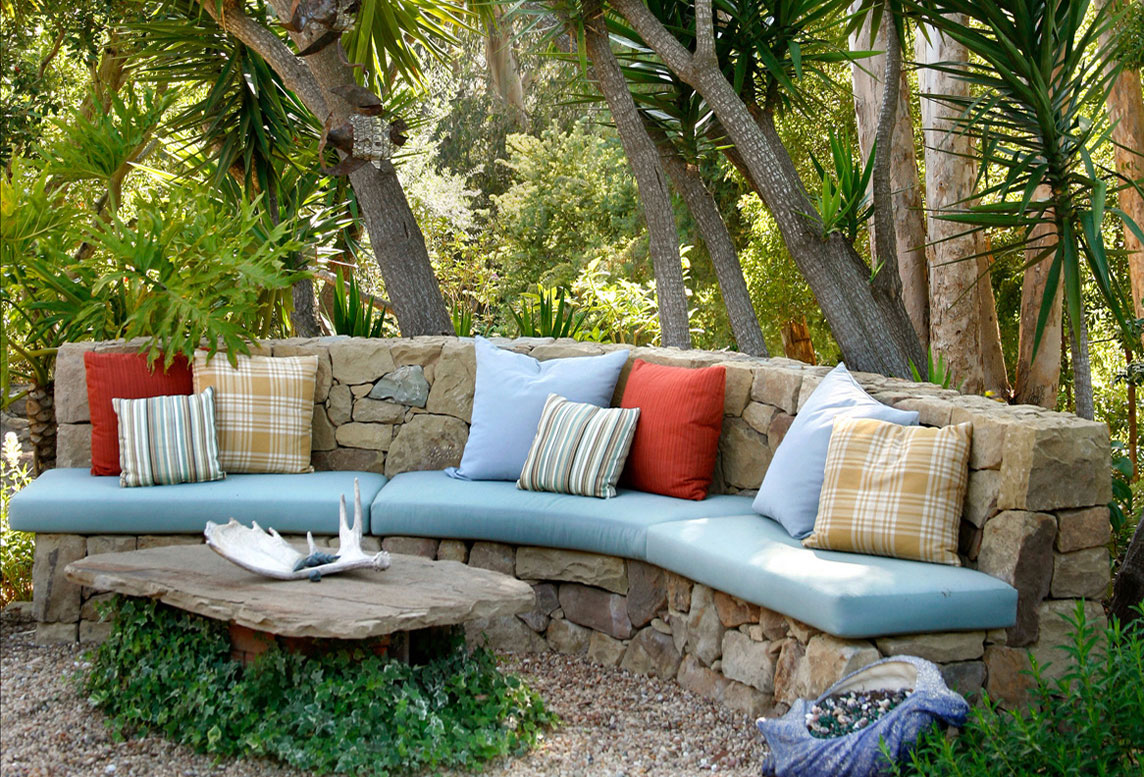
Every last piece of stone was used on site: for mounding, for walks, for walls (walls to control floodwaters, walls to retain soil, walls to create screening, etc.). Walls were given a variety of characters: from rustic stacked fieldstone to fitted gravity walls to mortared cut stone walls - and some were then "broken down" to differing degrees to suggest a long history of site occupation.
Simple plantings evoke a calligraphic Asian painting. Light, movement, views and a strong indoor-outdoor connection were incorporated into the design. Grasses were used extensively, minimizing landscape maintenance requirements and referencing the homeowners' prairie roots. The garden connects the house to the site, the neighborhood and the larger setting seamlessly.
(Note: All landscape elements were designed and built by the Grace Design Associates team. In addition, we consulted with the clients and architect regarding deck, shade louvers and step design.)
Green Features
- 95% of landscape materials are local (within 15 miles) or site-found, saving huge quantities of fuel/pollution for transportation.
- All plants, with the exception of a handful of fruit trees, are low water use and/or drought tolerant; all plantings are watered by an automated seasonally-adjusted drip irrigation system.
- Landscape mounding and boulder piles enhance site drainage, reduce total planted area/water use, create wildlife habitat, collect runoff and increase storm water percolation. A drainage "moat"surrounds the house. Bridged by stone in many places, the moat prevents runoff from puddling under the house and carries it to swales, preventing long-term house health (mold, rot) problems. Low water demand/high water use plants border the swaled areas, dewatering the soil swiftly.
- All hardscape is permeable, with the exception of the pre-existing asphalt driveway.
- Locally recycled material is used extensively as mulch throughout the gardens.
- Shade trees moderate temperature and glare.
- Aluminum louvers allow for a wide range of climate control: shade, sun, glare, air circulation


